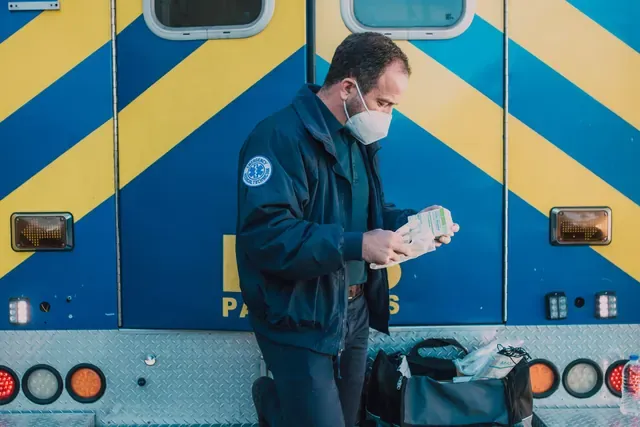

First responders and service members deal with death more often than almost anyone. It might be a stranger on a highway, a child on a call you'll never forget, a patient you'd been seeing for years, a crewmate lost in the line of duty, or a friend from the job lost to suicide. The culture often makes no room for grief. You clear the call, restock, and go back in service. The grief doesn't disappear. It waits.
This article looks at the kinds of grief that come with the work, what's normal, when grief becomes something more, and practical ways to carry it.
The kinds of grief the job brings
Grief in service isn't only about one death. Canada's OSISS peer network, run by National Defence and Veterans Affairs Canada, lists grief as one of the main contributors to operational stress injuries. In its description of these injuries it names:
- the loss of people you knew
- anticipatory loss
- the loss of "normal"
- the loss of your previous self
For responders, that often looks like:
- Line-of-duty or crewmate loss: the hardest, and often the most public, with ceremonies that can leave little space for private grief.
- Loss to suicide within the service: heavy with questions, anger and guilt, and too common.
- Cumulative grief from calls: hundreds of deaths of strangers, each one small enough to set aside, together a weight.
- Grief for who you were: the person who slept well, trusted easily and enjoyed things without scanning for danger.
- Grief at the end of a career: retirement or a medical release can mean losing identity, purpose and the crew all at once.
What normal grief looks like
The US National Center for PTSD's guide to grief reactions and timelines is clear: there's no right or wrong way to grieve, and no normal length of time. Common reactions include:
- Physical: disrupted sleep, changes in stress hormones and health, weakness, restlessness.
- Emotional: sadness, loneliness, fear, anxiety, anger. There may also be guilt when you start enjoying life again, as if you're betraying the person who died.
- Mental: trouble accepting the loss, poor concentration, swinging between avoiding the memory and being unable to stop thinking about it.
- Social: withdrawing, feeling self-conscious, struggling to connect.
The same guide notes that grief doesn't move through tidy stages. It comes in waves. Over time the waves usually space out and soften, but they can still hit hard on anniversaries, at a similar call, or for no clear reason. Many people keep an ongoing inner connection with the person they lost, and that's healthy, not a failure to move on.
When grief gets stuck
The National Center for PTSD estimates that around 1 in 10 bereaved people develop prolonged or complicated grief. This is a lasting, impairing reaction that can mix trauma symptoms with intense yearning. Signs include:
- a feeling that life is unbearable, or a sense of hopelessness
- preoccupation with the death, or intrusive images of it
- avoiding every reminder
- a wish to die to be with the person
- persistent guilt: believing you caused the death, should have prevented it, or should have been the one who died
For responders, that last one is especially common after a line-of-duty death or a call that went wrong. If these reactions last for months, cause significant distress or get in the way of daily life, treatment can help. There are effective therapies designed specifically for prolonged grief.
If grief brings thoughts of wanting to die, that's urgent. Call or text 988, or call 911 if you're in immediate danger.
Practical ways to carry it
- Make room on purpose. If the job doesn't give you time to grieve, take some. Visit the grave, the memorial or the place you used to go together, alone or with someone who knew them.
- Talk about the person, not just the death. Tell the stories, the funny ones too. Crews that keep a lost member's memory alive in ordinary conversation often grieve better than those that go silent.
- Mark the hard dates. Anniversaries and birthdays are predictable. Plan for them with company, a ritual, a lighter shift if you can.
- Watch the coping. Drinking to get through grief tends to stall it.
- Write to them. A letter to the person you lost, saying what you didn't get to say, is a simple and often powerful exercise. The 30-Day Journal includes prompts for processing difficult exposures that can help you start.
- Lean on people who knew them. Peer support from people who shared the loss can carry weight nobody else can.
Supporting a grieving crewmate
You don't need the right words. Say the person's name. Tell a story about them. Check in a month after the funeral, when everyone else has gone back to normal, and again on the anniversary. Offer something specific, like a coffee, a ride or a shift swap, instead of "Let me know if you need anything". And if your crewmate's grief starts to sound like hopelessness, ask them directly how they're coping and whether they're safe.
For the cumulative kind
The quiet grief from years of calls rarely gets named, so it rarely gets dealt with. It might show up as numbness, cynicism, or sudden tears at a commercial. Recognizing it as grief, and not as weakness or burnout, is often the first step. Our Survival Guide explains how years of exposure change your brain and why the culture makes this so hard to talk about.
You've spent a career showing up for other people's worst days. Your grief deserves the same care. If you'd like to talk with others who've carried losses like yours, our peer chat is there.
— Through the Fire
Sources
- Grief: Different Reactions and Timelines in the Aftermath of Loss, U.S. Department of Veterans Affairs, National Center for PTSD.
- Operational Stress Injury Social Support (OSISS), Canadian Forces Morale and Welfare Services.
This article is general information from people with lived experience, not medical advice. If you're struggling, talk to a qualified health professional.